Batching and factor reuse
When several systems share the same matrix A, construct one solver and reuse
it. Pass RHS vectors as columns of a matrix to solve them in one native batch:
solver = apxchol.factorize(A)       # setup once
B = np.column_stack((b1, b2))
batch = solver.solve(B, rtol=1e-8)
assert batch.converged.all()        # solutions: batch.x
This extends the Python quick start; each column has its own convergence result. See the Python batch interface and C++ matrix solve for shapes, output storage and initial guesses. MATLAB/Octave also accepts matrix RHSs.
Accounting for setup and reuse
Setup is paid once per solver. For a workload with several calls, measure setup plus all solves; dividing that total by the number of RHSs gives the amortized cost per system. Measure the first batch separately from later calls because it can allocate reusable workspace. Batch width, matrix structure and backend affect the benefit, so compare the same RHS columns with separate scalar calls using the same prepared solver.
Native batching is available on CPU, CUDA and Metal. The dated measurements below cover CPU and Metal; a qualified CUDA comparison is pending. For reuse across processes, see saving and loading.
Larger graph: YouTube
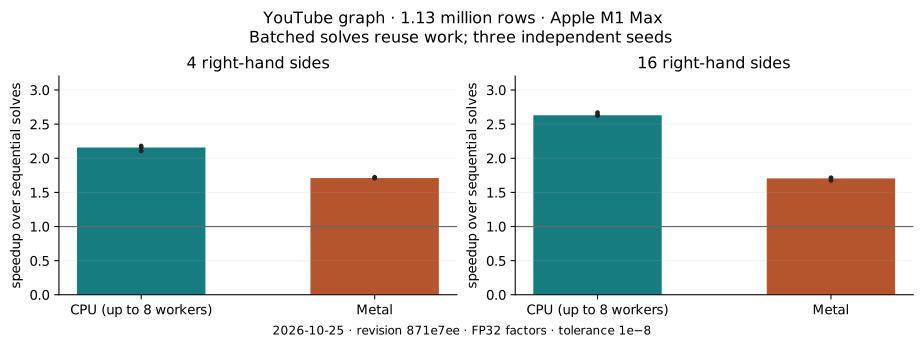
This comparison uses the unweighted Laplacian of
SNAP/com-Youtube: 1,134,890 rows and
7,110,138 stored entries. It ran on an Apple M1 Max with a ceiling of eight CPU
workers, FP32 factor storage and tolerance 1e-8. RHSs were normalized L*x
vectors from seeded random x.
CPU and Metal settings were chosen separately before three held-out seeds were
measured. Both selected degree quantile 0.2. Each plotted point is the ratio
between sequential scalar calls and one matrix call at the same width, reusing
that route’s factor. The bar shows the median of the three points.
Median time |
CPU |
Metal |
|---|---|---|
Setup + first scalar solve |
0.614 s |
0.617 s |
First scalar solve |
0.214 s |
0.240 s |
Reused four-column solve |
0.397 s |
0.512 s |
Reused sixteen-column solve |
1.284 s |
2.054 s |
There was no consistent setup-plus-one winner across these seeds. Batching helped both routes, while CPU finished the four- and sixteen-column solves sooner on this graph.
All three YouTube blocks passed the preregistered 5% control-variation gate and all 768 RHS checks passed. The full campaign also included Amazon and Grid5000; only zero and one of their three blocks passed that gate, respectively. They are omitted from the charts rather than presented as reliable speedups.
Measured on 2026-10-25, at
revision 871e7ee.
Download timings, settings and provenance.
These are native C++ API timings.
See benchmarking and reproducibility for the timing contract and larger comparisons.